
¿Qué es el costo total de propiedad y por qué es importante?

A product or part may seem low-cost at first glance, but the purchase price doesn’t always tell the full story. Have the additional costs of sourcing, using, maintaining, and replacing that product been considered?
It’s no surprise the primary focus for many companies is short-term savings, but the best value is derived by looking at the entire lifecycle. Total cost of ownership (TCO), sometimes referred to as total lifetime costs, helps businesses assess every cost associated with a product throughout its lifecycle.
Knowing the answer to “What is the total cost of ownership?” allows manufacturers to evaluate hidden expenses and identify opportunities for reducing total cost of ownership across operations.
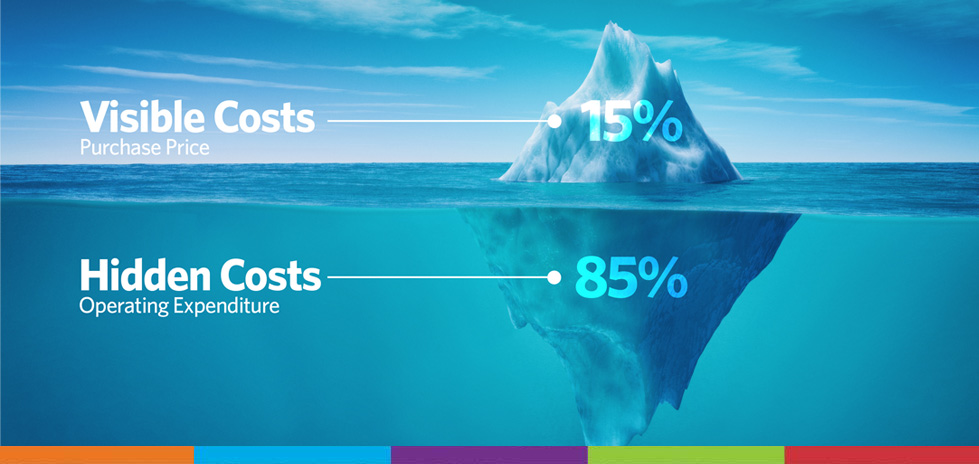
The Total Cost of Ownership Iceberg
A quick Google search for TCO reveals one key similarity between the many blogs and whitepapers on the topic: the iceberg analogy. Short-term costs, such as the initial purchase price, represent the tip of the iceberg above the waterline. Below the surface lies the much greater mass, representing the longer-term expenses, often referred to as hidden costs.
So, what exactly are these costs, and why is it so important for businesses to look at the lifecycle to establish total cost of ownership?
These hidden costs often contribute significantly to the total cost of ownership in supply chain operations, particularly when procurement, logistics, and la gestión del inventario are not fully optimized.
Cinco pasos para comprender el costo total de propiedad
Take product development as an example. Beyond the purchase price of an individual component or part, manufacturers need to consider costs involved across the whole cadena de suministro, including administration, sourcing, transport, quality, and performance.
There are five distinct steps to examine that provide a better understanding of these hidden costs.
- Preadquisición: Though arguably the most important step, pre-acquisition can involve significant costs. This step can include research and sourcing, negotiations, visits, paseos en línea, and testing.
- Adquisición: After manufacturers have selected their component and are satisfied with the quote, they also need to consider delivery (logistics and transportation), installation, training, and spares.
- Operando: Once in use on a busy 24/7 production line, costs can include materials and energy consumption, as well as supplementary products and services required to keep parts performing effectively.
- Mantenimiento: Whether it’s planned preventative maintenance or an unexpected breakdown or repair, both can add costs through downtime and lost production time.
- Fin del ciclo de vida: Once designs are refined or a new variant is launched, certain parts may no longer be required. This can introduce additional costs for decommissioning, disassembly, or reconfiguring supporting production equipment and tooling. There may also be disposal costs if stock holding has been miscalculated.
Beyond these costs, manufacturers must also consider operating expenditure (OpEx) or indirect costs, including but not limited to:
- Administración General
- Trabajo
- Gestión de proveedores
- Finanzas
- Calidad
- Ingeniería
- La gestión del inventario
While this is only a high-level overview of costs that may be involved during the entire lifecycle, it clearly illustrates total cost of ownership and how expenses can quickly escalate if not carefully considered and planned.
¿Cómo reducir su costo total de propiedad?
Some of the steps outlined above are more applicable to fully built and assembled products, such as machinery.
Take a CNC machine sitting on a busy shop floor, for example. Through regular use, the machinery or tooling is subject to constant wear and tear, as well as damage from airborne contaminants and dirt ingress. In this instance, maintenance costs would need significant consideration when calculating total cost of ownership.
So, how does this methodology come into play with much smaller, but no less essential parts — the very parts that hold this machinery together? When it comes to fasteners, TCO isn’t always such an obvious proposition.
When considering parts and components such as fasteners (bolts, nuts, rivets, etc.), it’s useful to understand the importance of a Inventario administrado por el proveedor (VMI). By using a VMI, the vendor holding the manufacturer’s stock (or MOQ) assumes all the cost and associated risk.
VMI plays a key role in lowering total cost of ownership by addressing hidden operational expenses throughout the supply chain by:
- Helping to control operating costs including labeling, packaging, and the storage of thousands of parts. It’s estimated that an average car is built using more than 3,500 fasteners, while an airplane can contain over one million. Granted, these are extreme examples, but they illustrate just how much space these fasteners can consume in a production line environment. A VMI program can help manufacturers reclaim physical space while having a efecto positivo en el flujo de caja al reducir los requisitos de tenencia de acciones.
- Reducing the number of staff needed to perform inventory management tasks. Managing countless purchase orders, handling products upon delivery, and overseeing the goods-in process — from locating the parts in the correct area to ensuring they’re placed in correctly labelled bins — all require valuable time and resources. If mismanaged, these processes can also expose the production line to unnecessary risk.
- Lowering acquisition costs, which can result in significant upfront savings for customers. By leveraging a strong cadena de suministro, buying in higher volumes, and consolidating parts to control freight charges, manufacturers are guarding against price increases and unexpected import duties/tariffs. Additionally, a VMI can also allow the vendor to act as a buffer against potential supply issues, helping secure stock for the long-term.
Looking to get more from your inventory management program? Discover Optimas’ secrets to building a successful VMI strategy.
Consolidar y ahorrar
It’s not just VMIs themselves that need to be considered. Manufacturers also need to take a step back and look at the products that these VMI programs are based upon.
Take direct materials, such as sujetadores y Componentes de la Clase C, for example. These high-volume items can prove difficult to manage, and the same considerations apply to other products that fit the same criteria.
Personal protective equipment (PPE) such as face masks, gloves, and workwear, along with suministros Industriales, including abrasives, adhesives, and consumables, are essential for everyday operations. But do businesses really see the best ROI by tying up skilled team members in managing these parts?
Sourcing from fewer suppliers means fewer invoices and, subsequently, less time spent by staff cross-checking incoming stock. General vendor consolidation can help manufacturers save significant amounts of time, cost, and effort across operations.
Take Control of Your Total Cost of Ownership
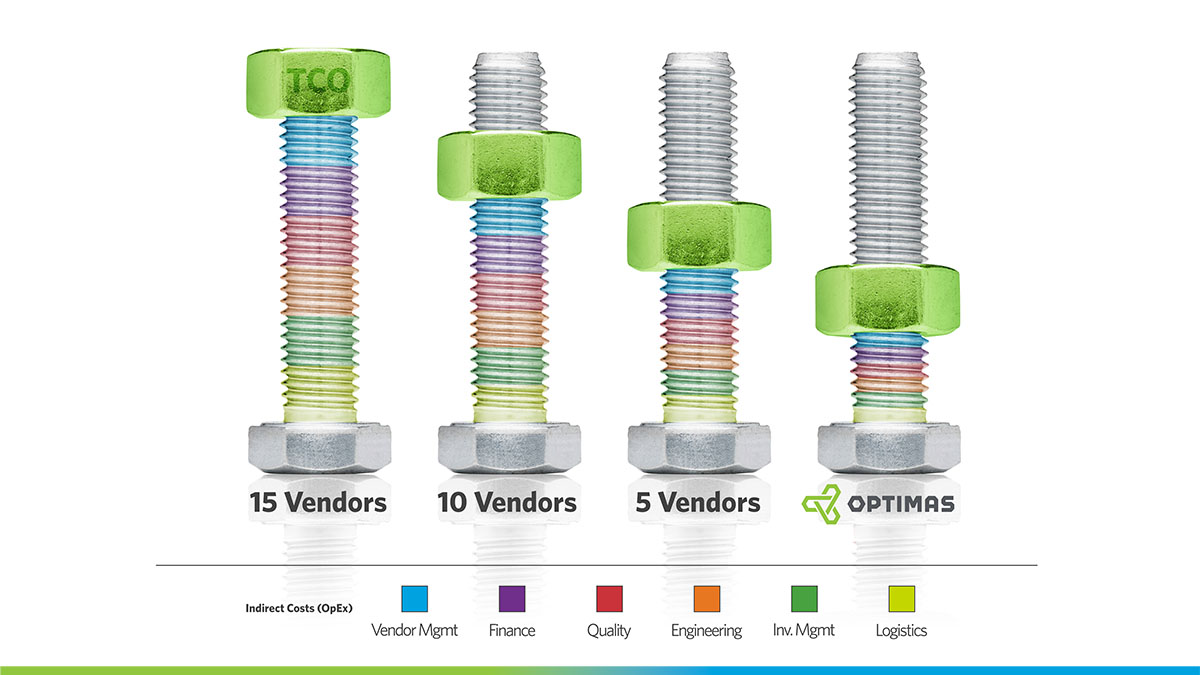
By consolidating vendors, implementing VMI programs, and improving procurement strategies, manufacturers can significantly reduce expenses while improving efficiency across the supply chain total cost of ownership model.
With nearly 50 years of experience, Optimas understands customers’ requirements and can rapidly adapt to meet their needs. That all starts with finding innovative ways to reduce costs.
Although not an iceberg, our bolt graphic illustrates how partnering with Optimas and reducing vendors can help reduce hidden costs over time.
Reach out to an Optimas expert today to identify key ways to reduce your total cost of ownership.
4 Comments
Los comentarios están cerrados.


 Español de México
 English
 Español
 简体中文
 香港中文
 Français
 Türkçe
 Deutsch
 Italiano
 日本語
 English (UK)
 Français du Canada

[…] Además, el uso de una VMI puede simplificar y reducir el costo del proceso de pedido, al mismo tiempo que reduce su TCO (costo total de propiedad), ya que el proveedor asume el costo y el riesgo asociado de administrar su cadena de suministro. Asociación con […]
[…] Reducción: Las VMI pueden reducir enormemente el gasto de una empresa al reducir su costo total de propiedad. Como VMI obtiene piezas automáticamente, evita perder tiempo y dinero en tareas innecesarias.
[…] una VMI puede simplificar y reducir el costo del proceso de pedido, al mismo tiempo que reduce el TCO (costo total de propiedad) de una empresa, ya que el proveedor asume el costo y el riesgo asociado de administrar su suministro […]
[…] Un servicio de inventario administrado por el proveedor también tiene como objetivo reducir el inventario tanto como sea posible, ya que el exceso de existencias puede ocupar un espacio físico valioso, además de afectar negativamente las ganancias y la productividad. El exceso de existencias puede costarle a un fabricante una cantidad significativa de dinero, ya que puede ser difícil de revender y requiere una cantidad considerable de recursos humanos para moverlas y administrarlas, lo que contribuye al alto costo de propiedad. […]