
総所有コストとは何ですか? なぜ重要なのですか?

A product or part may seem low-cost at first glance, but the purchase price doesn’t always tell the full story. Have the additional costs of sourcing, using, maintaining, and replacing that product been considered?
It’s no surprise the primary focus for many companies is short-term savings, but the best value is derived by looking at the entire lifecycle. Total cost of ownership (TCO), sometimes referred to as total lifetime costs, helps businesses assess every cost associated with a product throughout its lifecycle.
Knowing the answer to “What is the total cost of ownership?” allows manufacturers to evaluate hidden expenses and identify opportunities for reducing total cost of ownership across operations.
The Total Cost of Ownership Iceberg
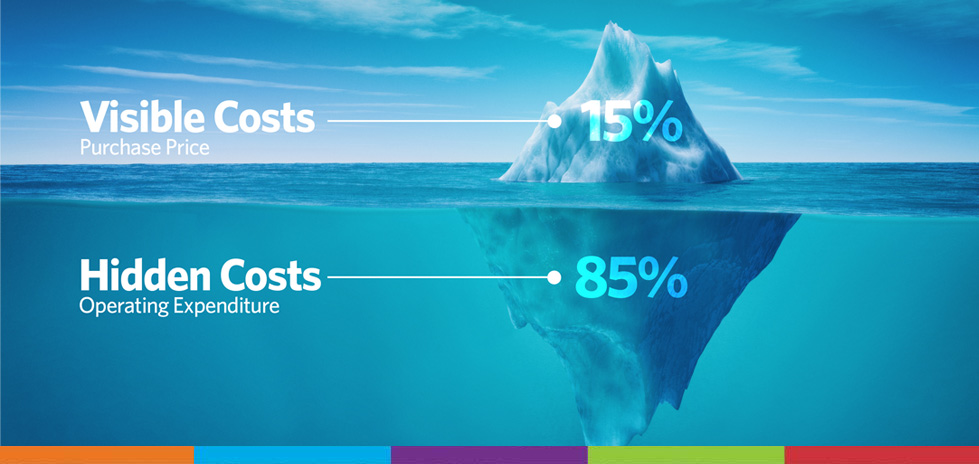
A quick Google search for TCO reveals one key similarity between the many blogs and whitepapers on the topic: the iceberg analogy. Short-term costs, such as the initial purchase price, represent the tip of the iceberg above the waterline. Below the surface lies the much greater mass, representing the longer-term expenses, often referred to as hidden costs.
So, what exactly are these costs, and why is it so important for businesses to look at the lifecycle to establish total cost of ownership?
These hidden costs often contribute significantly to the total cost of ownership in supply chain operations, particularly when procurement, logistics, and 在庫管理 are not fully optimized.
総所有コストを理解するための 5 つのステップ
Take product development as an example. Beyond the purchase price of an individual component or part, manufacturers need to consider costs involved across the whole サプライチェーン, including administration, sourcing, transport, quality, and performance.
There are five distinct steps to examine that provide a better understanding of these hidden costs.
- 買収前: Though arguably the most important step, pre-acquisition can involve significant costs. This step can include research and sourcing, negotiations, visits, ラインウォーク, and testing.
- 取得: After manufacturers have selected their component and are satisfied with the quote, they also need to consider delivery (logistics and transportation), installation, training, and spares.
- オペレーティング: Once in use on a busy 24/7 production line, costs can include materials and energy consumption, as well as supplementary products and services required to keep parts performing effectively.
- メンテナンス: Whether it’s planned preventative maintenance or an unexpected breakdown or repair, both can add costs through downtime and lost production time.
- ライフサイクルの終了: Once designs are refined or a new variant is launched, certain parts may no longer be required. This can introduce additional costs for decommissioning, disassembly, or reconfiguring supporting production equipment and tooling. There may also be disposal costs if stock holding has been miscalculated.
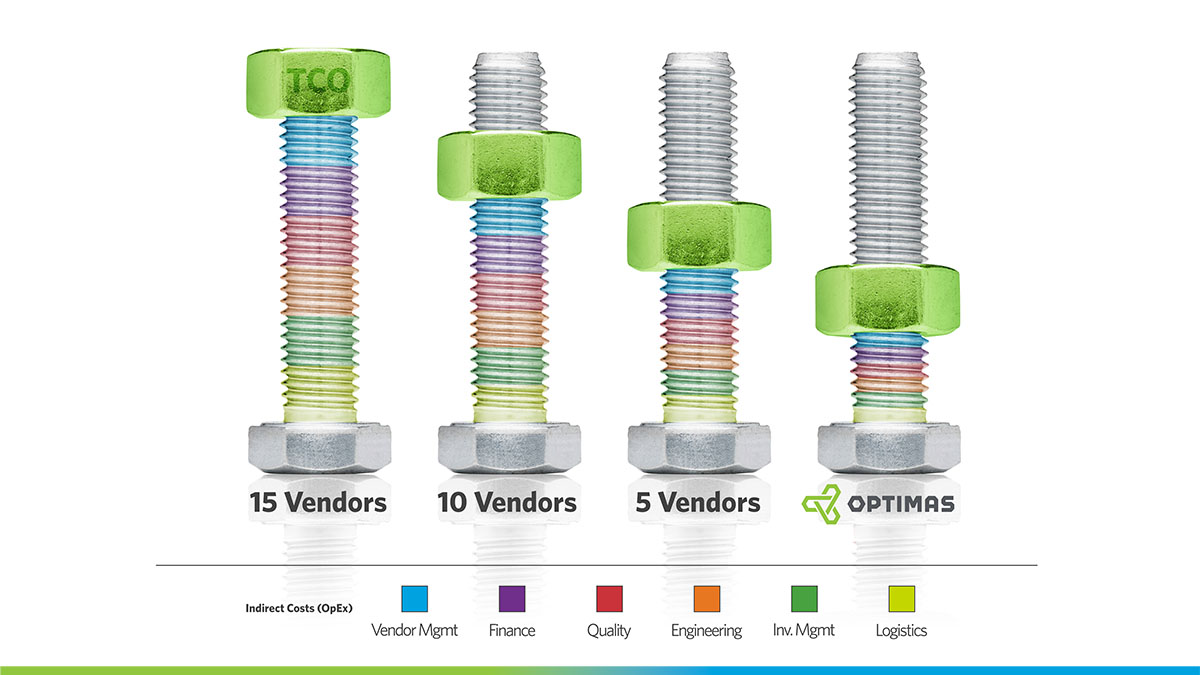
Beyond these costs, manufacturers must also consider operating expenditure (OpEx) or indirect costs, including but not limited to:
While this is only a high-level overview of costs that may be involved during the entire lifecycle, it clearly illustrates total cost of ownership and how expenses can quickly escalate if not carefully considered and planned.
総所有コストを削減するにはどうすればよいでしょうか?
Some of the steps outlined above are more applicable to fully built and assembled products, such as machinery.
Take a CNC machine sitting on a busy shop floor, for example. Through regular use, the machinery or tooling is subject to constant wear and tear, as well as damage from airborne contaminants and dirt ingress. In this instance, maintenance costs would need significant consideration when calculating total cost of ownership.
So, how does this methodology come into play with much smaller, but no less essential parts — the very parts that hold this machinery together? When it comes to fasteners, TCO isn’t always such an obvious proposition.
When considering parts and components such as fasteners (bolts, nuts, rivets, etc.), it’s useful to understand the importance of a ベンダー管理在庫 (VMI). By using a VMI, the vendor holding the manufacturer’s stock (or MOQ) assumes all the cost and associated risk.
VMI plays a key role in lowering total cost of ownership by addressing hidden operational expenses throughout the supply chain by:
- Helping to control operating costs including labeling, packaging, and the storage of thousands of parts. It’s estimated that an average car is built using more than 3,500 fasteners, while an airplane can contain over one million. Granted, these are extreme examples, but they illustrate just how much space these fasteners can consume in a production line environment. A VMI program can help manufacturers reclaim physical space while having a 在庫保有要件の削減によるキャッシュフローへのプラス効果.
- Reducing the number of staff needed to perform inventory management tasks. Managing countless purchase orders, handling products upon delivery, and overseeing the goods-in process — from locating the parts in the correct area to ensuring they’re placed in correctly labelled bins — all require valuable time and resources. If mismanaged, these processes can also expose the production line to unnecessary risk.
- Lowering acquisition costs, which can result in significant upfront savings for customers. By leveraging a strong サプライチェーン, buying in higher volumes, and consolidating parts to control freight charges, manufacturers are guarding against price increases and unexpected import duties/tariffs. Additionally, a VMI can also allow the vendor to act as a buffer against potential supply issues, helping secure stock for the long-term.
Looking to get more from your inventory management program? Discover Optimas’ secrets to building a successful VMI strategy.
統合して節約
It’s not just VMIs themselves that need to be considered. Manufacturers also need to take a step back and look at the products that these VMI programs are based upon.
Take direct materials, such as 留め具 と Cクラスのコンポーネント, for example. These high-volume items can prove difficult to manage, and the same considerations apply to other products that fit the same criteria.
Personal protective equipment (PPE) such as face masks, gloves, and workwear, along with 工業用品, including abrasives, adhesives, and consumables, are essential for everyday operations. But do businesses really see the best ROI by tying up skilled team members in managing these parts?
Sourcing from fewer suppliers means fewer invoices and, subsequently, less time spent by staff cross-checking incoming stock. General vendor consolidation can help manufacturers save significant amounts of time, cost, and effort across operations.
Take Control of Your Total Cost of Ownership
By consolidating vendors, implementing VMI programs, and improving procurement strategies, manufacturers can significantly reduce expenses while improving efficiency across the supply chain total cost of ownership model.
With nearly 50 years of experience, Optimas understands customers’ requirements and can rapidly adapt to meet their needs. That all starts with finding innovative ways to reduce costs.
Although not an iceberg, our bolt graphic illustrates how partnering with Optimas and reducing vendors can help reduce hidden costs over time.
Reach out to an Optimas expert today to identify key ways to reduce your total cost of ownership.
4 Comments
コメントは締め切りました。



 日本語
 English
 Español de México
 Español
 简体中文
 香港中文
 Français
 Türkçe
 Deutsch
 Italiano
 English (UK)
 Français du Canada

[…] さらに、VMI を使用すると、発注プロセスを簡素化してコストを削減できるだけでなく、ベンダーがサプライ チェーンの管理にかかるコストと関連するリスクを引き受けるため、TCO (総所有コスト) も削減できます。[…] と提携することで、
[…] 削減: VMI は総所有コストを削減することで、企業の支出を大幅に削減できます。VMI は自動的に部品を調達するため、不必要な時間と費用を無駄にすることがなくなります […]
[…] VMI は発注プロセスを簡素化し、コストを削減できると同時に、サプライヤーが供給管理のコストと関連リスクを負うため、企業の TCO (総所有コスト) も削減できます […]
[…] ベンダー管理在庫サービスでは、在庫を可能な限り削減することも目的としています。過剰在庫は貴重な物理的スペースを占有するだけでなく、利益と生産性に悪影響を与える可能性があるためです。過剰在庫は再販が困難で、移動と管理にかなりの人的資源が必要になるため、メーカーに多大なコストがかかる可能性があり、所有コストの上昇につながります。 […]