
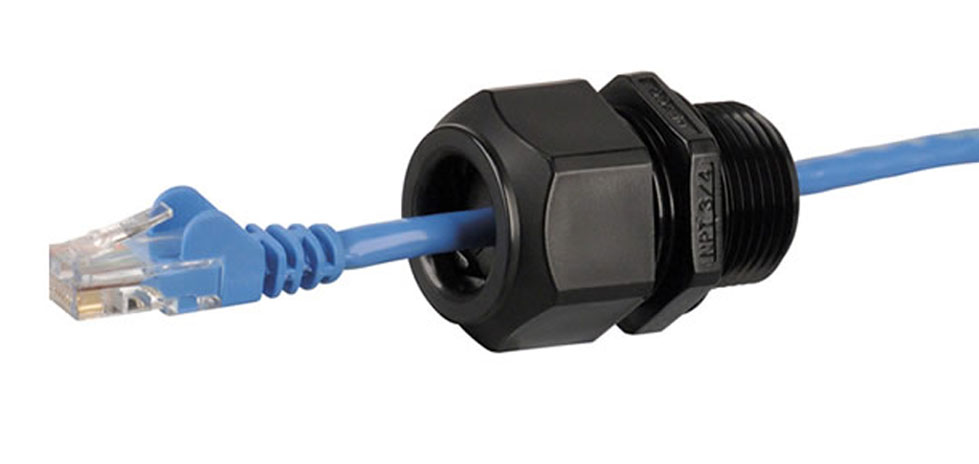
Split Cable Glands and Cable Gland Solutions from a Single Source

Optimas has extended its cable gland offering for industrial, hygienic, and ATEX applications, including split cable glands for pre-terminated cables.
Customers now have access to a broader selection of standard and specialized cable glands from a range of leading brands. Designed to support multiple cable entry requirements across industrial and challenging application environments, the extended range includes multiple sealing styles, materials, cable retention options, and cable protection solutions.
For requirements beyond standard product ranges, Optimas engineering teams can also customize glands to meet specific application requirements.
Standard and Specialized Cable Glands
The expanded stock portfolio includes products from several well-known brands, with cable gland options ranging from popular nylon and nickel-plated brass products to Flex Protect and 90-degree cable glands. These specialized options support applications requiring flexible cable routing, enhanced protection, and reliable performance in demanding environments.
Many designs are also available with specialized features, including high-temperature performance, chemical resistance, and higher strain relief. These options give customers more flexibility when specifying cable glands for demanding industrial environments, equipment enclosures, and cable entry applications.
Learn more about Optimas’ cable protection solutions for extreme environments.
Split Cable Glands for Pre-Terminated Cables
Standard threaded cable glands are not suitable for every application, especially when cables are pre-assembled with connectors or terminals. For these requirements, Optimas offers alternative cable gland designs such as snap-in glands that enable faster assembly while providing reliable IP protection and secure cable retention.
Vented cable glands are also available for applications where condensation management is important. Their breathable design allows air expansion and contraction through the enclosure, helping equalize pressure and minimize moisture buildup.
For pre-terminated cables, split cable glands enable installation without removing connectors or disrupting existing cable assemblies. These split cable glands for pre-terminated cables provide reliable sealing at clearance or threaded mounting locations while simplifying installation, maintenance, and retrofit applications.
Hygienic Cable Glands
Optimas also provides cable gland solutions for hygienic applications across pharmaceutical, medical, food, and beverage environments. Smooth cable gland designs are available with IP68 or IP69K ingress protection across the range.
For applications with limited installation space, low-profile cable glands are also available with IP69K protection as standard. Their compact design makes them well suited for demanding hygienic environments where cleanability, sealing performance, and space efficiency are important.
ATEX Cable Glands
Cables used in potentially explosive atmospheres require carefully specified protection, making proper cable gland selection critical to safety and performance. Optimas offers a range of standard EX and ATEX-rated cable glands, along with specialized options designed to meet additional application and performance requirements.
By working with approved suppliers, Optimas helps customers specify suitable cable glands for hazardous environments, while supporting quality assurance and greater versatility across industrial and ATEX applications.
50 Years of Expertise in Split Cable Glands for Pre-Terminated Cables
Optimas offers nearly 50 years of experience providing high-quality components and technical support to customers worldwide.
Whether customers need standard cable glands, ATEX-rated cable glands, hygienic cable glands, or split cable glands for pre-terminated cables, Optimas combines extensive product choice with technical expertise to identify the right solution.
To explore the full range of Optimas cable glands, contact the Optimas team for support with application-specific requirements.





 Français
 English
 Español de México
 Español
 简体中文
 香港中文
 Türkçe
 Deutsch
 Italiano
 日本語
 English (UK)
 Français du Canada