
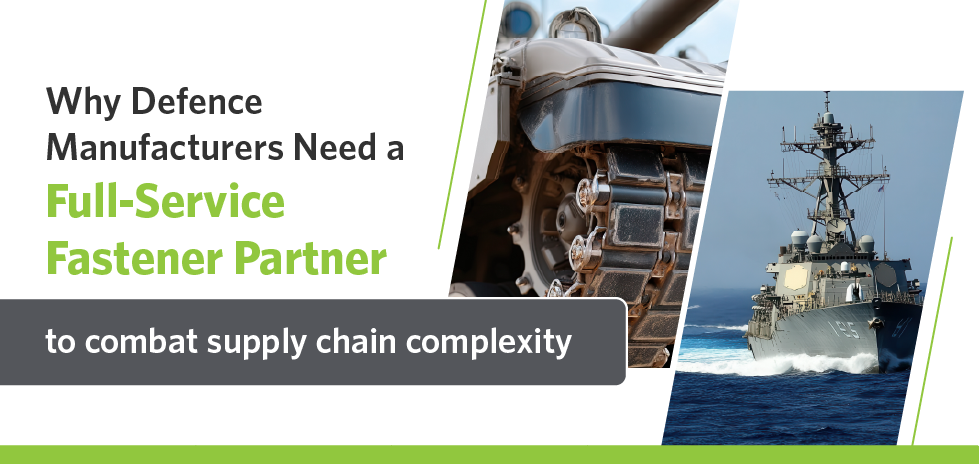
Why Defence Manufacturers Need a Full-Service Fastener Partner to Combat Supply Chain Complexity

The defence industry supply chain is extremely complex. Whether for land vehicles or naval vessels, every component must be able to withstand extreme loads, demanding conditions and brutal environments. Yet defence OEMs and Tiers have to deal with a complex supply chain containing vast networks of suppliers across the globe and rigid legacy systems.
Inside this blog, we will explore:
- The complexity of defence supply chains
- Risks in the defence supply chain
- Strategies to mitigate risk
The Complexity of Defence Supply Chains
Defence equipment such as armoured vehicles or naval ships contains thousands of parts, a significant proportion of which are fasteners and other C-class components. Fasteners alone can account for around 50% of the bill of materials while representing only 1% of the total cost. Managing this high volume of small but essential components is a challenge in itself.
Moreover, defence OEMs and Tier manufacturers rely on layers of a complex supply chain for these parts. Visibility often drops off beyond the first tier. As a result, this limited visibility makes it hard to anticipate issues hidden deep in the supply network, increasing the likelihood of disruptions to production lines and longer lead times.
Additionally, defence supply chains have historically relied on highly globalised networks, where many critical components and raw materials are predominantly single-sourced internationally, increasing exposure to disruption. This can create bottlenecks. All these elements intertwine to form a complex supply chain that defence manufacturers must manage.
Risks in the Defence Supply Chain
Global events in recent years have underscored how fragile supply chains can be. Geopolitical conflicts and trade disruptions make an enormous impact on defence supply lines.
For instance, surges in industry demand (such as European rearmament plans) are putting strain on both defence OEMs and Tiers, leading to potential longer lead times or shortages for key components.
Supply interruptions can arise for many reasons. Raw material shortages, plant shutdowns and transportation delays are just a few examples. Just one delayed delivery of fasteners can halt an entire assembly, incurring costly line stoppages.
Strategies to Mitigate Supply Chain Risk
To reduce complexity and risk, defence organisations are adopting several best practices. Key risk mitigation strategies include:
End-to-End Visibility: Improve transparency across the defence supply chain by mapping out critical components and suppliers. Identifying which parts are single-sourced or at risk of shortage allows for proactive measures. Continuous monitoring of supply conditions (lead times, stock levels, geopolitical factors) helps predict issues before they hit.
Supplier Diversification: Avoid single points of failure by qualifying alternate sources for important parts. Whenever feasible, develop a dual-source strategy, so if one supplier cannot deliver, another can fill the gap.
Strengthen Supplier Partnerships: Close collaboration with suppliers is crucial. Defence OEMs and Tier manufacturers should engage with suppliers to communicate demand forecasts, share production plans, and align on inventory targets.
Inventory Management: Optimising inventory is a balancing act. Carrying too much stock is costly, but too little invites disaster. Many defence OEMs and Tiers are turning to vendor-managed inventory (VMI) and just-in-time delivery through reliable distributors to keep production lines fed without holding excessive stock. The goal is to have the right parts in the right quantity at the right time.
Agility and Rapid Response: Since not all disruptions can be prevented, having an agile response capability is key. This could mean establishing a task force for expediting critical supplies or leveraging partners with quick-turn manufacturing services.
Implementing these strategies helps defence supply chains become more robust and easier to navigate for defence OEMs and Tier manufacturers. However, executing them often requires the right expertise and resources, which is where choosing the right supply chain partners comes in.
Optimas: Full-Service Fastener Partner for Defence Leaders
Navigating defence supply chain complexity is easier with a strong partner at your side. Optimas is a global manufacturer and distributor of fasteners, custom-engineered fastener solutions, and C-class components, with a wealth of experience supporting OEMs and Tier manufacturers through bespoke technical and operational solutions.
This breadth of products and services means Optimas can act as a one-stop solutions provider for defence OEMs and Tier manufacturers, helping to simplify the supply chain. Instead of managing dozens of small part vendors, manufacturers in the defence industry can rely on Optimas to source and manage a wide variety of standard fasteners, engineered parts, and C-class components, all consolidated under a single strategic supplier. This consolidation reduces complexity while ensuring consistent quality and availability.
Contact us here to see how Optimas can support your manufacturing projects.
 Celebrating Excellence: IFE 2025 Supplier Awards
 English
  Español de México
  Español
  简体中文
简体中文  香港中文
香港中文  Français
  Türkçe
  Deutsch
  Italiano
  日本語
日本語  English (UK)
  Français du Canada