
Engineering Better Automotive Wheel Fasteners for Vehicle Performance

The automotive industry continues to grow, with the automotive wheel market experiencing significant expansion of its own.
Valued at $31.4 billion in 2021, the market is expected to register a compound annual growth rate (CAGR) of 6.10% from 2023-2028, signaling continued growth in the years ahead.
Demand for Wheel Fasteners in the Automotive Industry
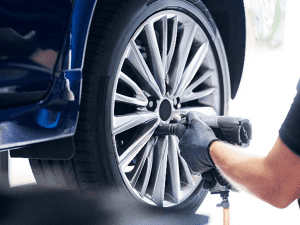
Torque-limited wheel gun
Automotive wheel systems predominantly rely on wheel bolts or wheel studs and nuts, all of which are critical wheel fasteners requiring high standards of design, manufacturing, and assembly. These fasteners must meet the demanding performance and durability requirements to support long-term reliability.
Additionally, security is an important consideration when selecting automotive wheel fasteners. Anti-theft designs can make it more difficult for criminals to remove wheels or tires from vehicles by requiring uniquely designed locking keys to remove locking wheel nuts.
Wheel fasteners used in automotive applications must meet high tolerance demands, bearing loads between 65-90% of their yield strength to help prevent loosening, or in severe cases, shearing. Additionally, fasteners used in wheel applications must also withstand significant vibration to maintain clamp load effectively.
Using incorrect or insufficient quality wheel bolts or nuts can potentially cause the wheel to loosen, affect tire pressure, and compromise handling. In extreme cases, these issues can lead to a loss of vehicle control and increase the risk of personal injury.
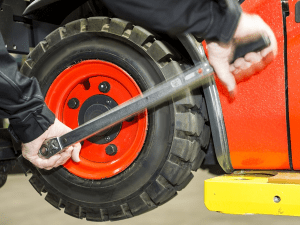
Calibrated torque wrench
Automotive wheel fasteners also need to be highly corrosion-resistant to withstand environmental conditions, including extreme temperatures, road salt, and chemicals used in processes like car washing.
Using fasteners made from corrosion-resistant materials or treated with protective platings can increase a vehicle’s durability and help maintain consistent performance across different environments and temperatures.
In addition to these factors, minimizing wheel weight is key for any automotive build. Excess weight from wheel fasteners can lead to a decrease in fuel efficiency, increase in harmful emissions, and additional pressure on the vehicles tires, potentially reducing their lifespan and resulting in further safety concerns.
When Automotive Wheel Fasteners Fail
Improper installation methods, manufacturing processes, or testing of wheel fasteners can all contribute to fastener failure and create significant safety risks.
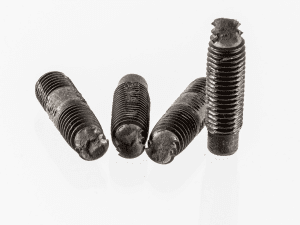
Damaged wheel bolts
A study on the automotive industry in the United States found that 23% of service problems were attributed to threaded fastener relaxation, while 12% of new vehicles experienced inadequate clamp load in their thread fasteners.
Consequently, it is critical that automotive wheel fasteners are tightened to the specified torque for their particular application. The appropriate torque value depends on several factors, including diameter, tensile strength, bearing surface area, and coefficient of friction.
Wheel bolts and nuts should always be tightened using calibrated, specialized tools, such as torque limited air wrenches. They should be checked by using a torque wrench rather than by judgement alone. Mounting wheel bolts should also be started by hand to help prevent fastener misalignment and damage to its seat, with the correct tools used to control the tightening torque.
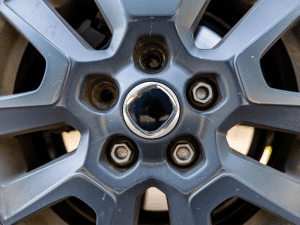
Broken wheel nuts
In some cases, incorrect fastener selection can contribute to vehicle failure. If the bolts are too long, they can create a clash condition by interfering with other parts, potentially resulting in wheel locking.
It’s also vital to use the correct type of fastener for the required mount. For example, using conical seat fasteners in the wheels with spherical mounting seats, or vice versa, can cause wheel misalignment and lead to loosening of the threaded connection.
The choice of corrosion protection on automotive wheel fasteners, such as wheel bolts, is a key element in fastener selection. Due to the harsh environments in which these components must operate, they may become susceptible to oxidation and corrosion over time. To help protect wheel bolts from corrosion-related failure, it is advisable to treat them during production by galvanizing, anodizing, or electroplating.
Due to the load-bearing requirements of wheel bolts, a common choice is to specify high tensile fasteners. However, fasteners where the core or surface hardness is above 320HV can be susceptible to hydrogen embrittlement. This occurs when fasteners become weakened and brittle as a result of the introduction and diffusion of hydrogen into the material during the electroplating process of finishing.
The risk of hydrogen embrittlement can be mitigated through a de-embrittlement process. This typically involves baking the fastener within four hours of plating at a temperature of between 200ºC to 230ºC for 2-24 hours.
Alternatively, selecting a corrosion protection option that does not use an electroplating process can reduce the risk of introducing hydrogen gas during the finishing process and, consequently, reduces the need for de-embrittling.
Zinc-aluminium flake finishes, applied through a dip-spin method, do not induce hydrogen embrittlement and are a safer option for use on high-tensile fasteners like wheel bolts.
The Benefits of Cold-Forming Wheel Bolts
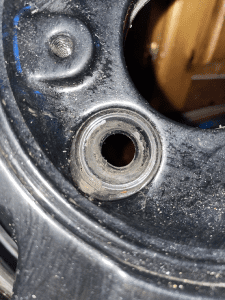
Damaged wheel bolt hole
One highly effective process for manufacturing wheel bolts is through cold forming. The process begins with a wire or rod made from a variety of materials, which is shaped using punches and dies to achieve the desired form without removing material.
This is a repeatable, cost-effective manufacturing option that requires minimal machining and little to no finishing work, with the added benefit of producing minimal waste from the manufacturing process.
The cold forming process offers excellent dimensional accuracy at high-speed production rates, helping maintain consistent wheel bolt size and shape while meeting the demands of the automotive industry. This precision is critical for proper wheel assembly and safety.
In summary, cold forming is an effective manufacturing method for wheel bolts, combining efficiency, precision, and material optimization. These advantages support the cost-effective production of high-quality components that meet the stringent safety requirements of the automotive industry.
To learn more, read about the benefits of cold-form manufacturing.
Optimas: Advancing Fastener Performance Through Engineering and Quality
Optimas supports automotive manufacturers with expert engineering services to help prevent potential fastening issues and provide the quality fasteners needed for demanding vehicle applications.
To deliver a best-in-class product range of fasteners and components, Optimas’ work goes beyond identifying the best suppliers. Optimas conducts a rigorous qualification process to ensure suppliers can manufacture high-quality parts at the volumes required, when they’re needed. Optimas works closely with suppliers to continuously improve product performance and capabilities to support customers in every aspect of their supply chain.
Plus, Optimas’ dedicated team of fastener engineers can work on a project basis or on-site with OEMs’ engineering departments. This close collaboration allows Optimas to play an active role from product development to the assembly line, helping improve quality and productivity at every stage
By sourcing nuts, bolts and screws locally and onshoring supply, lead times can be significantly reduced from PO to delivery. Simplified transportation can also help reduce environmental impact while creating a more resilient supply chain.
For greater efficiency, quality, and security, partner with Optimas for your fastener needs and let us help de-risk your supply chain.




 English
 Español de México
 Español
 简体中文
 香港中文
 Français
 Türkçe
 Deutsch
 Italiano
 日本語
 English (UK)
 Français du Canada